
The way land records are maintained in Hyderabad can be a rather complex task for the common man to navigate. This is caused by a combination of historical practices at the state and national levels. This history needs to be known to understand the issue properly and gain better clarity.
In this article, our goal is to educate common public to comprehend these details. Specifically, the role of the ‘Are’ measurement unit in the metric system.
Urban Land Surveys and TSLR in Hyderabad were initiated in the early 1970s
During the administration of Sri PV Narasimha Rao as the CM of Andhra Pradesh from 1971 to 1973, the Town Survey process was started in the core Hyderabad. This exercise was undertaken to bring order, accuracy, and legal clarity to urban land records in a rapidly expanding area. This continued in phases till the early 1980s in newly urban areas.
The Town Survey was a systematic cadastral survey of urban lands. Field teams would measure land parcels, identify boundaries, and record ownership. At the same time, entries were made into the TSLR (Town Survey Land Register)
These state authorities designed the TSLR format (Hectare–Are–Sq.m structure). They also standardized the parcel numbering (TS numbers), classification of land (government/private/road, etc.), and mapping procedures and field measurement methods. They largely followed the national Survey of India practices, but the TSLR system itself was a state-specific, not a central standard. TSLR provided measured parcel extents, clear survey numbers (TS numbers), and basic ownership and classification data.
 ULC Act, 1976 and its Implications
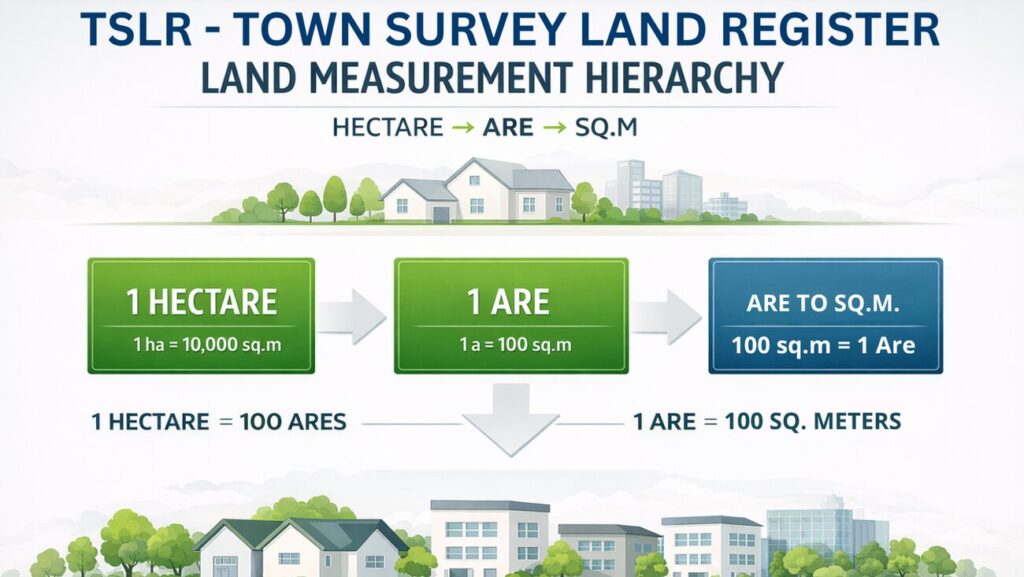
The Urban Land (Ceiling and Regulation) Act, 1976, was passed by the Parliament of India, and it set rules for maximum land holding (ceiling limits) in urban areas across India. Under the Urban Land (Ceiling and Regulation) Act, 1976, the government identified privately held urban land above a prescribed ceiling and classified it as “surplus.”
In theory, such land was acquired by the state through a legal process involving notifications and modest compensation, after which ownership transferred to the government. The core objective was redistributive—using this land to support low-income housing, slum rehabilitation, and public infrastructure like roads, parks, and civic facilities. Much of the land, which was successfully acquired, was routed to development bodies and housing boards for planned use.
How TSLR records helped the ULCA implementation?
ULCA authorities needed exactly this information to assess land holdings, identify “vacant land,” and determine surplus land. In cities like Hyderabad, TSLR made ULCA more workable and verifiable.
TSLR record conversion to Sq. Meters for ULC purpose
The ULC Act applied only to notified urban agglomerations, not rural areas. Cities were classified into A to D categories. Limits were defined in square meters per person/family unit. Based on the city category, which ranged from 500 sq meters to 2000 sq meters.
In Hyderabad, the TSLR records in Hectare – Are – Square Meters unit measurements had to be converted to Square meters to evaluate proceedings under ULC.
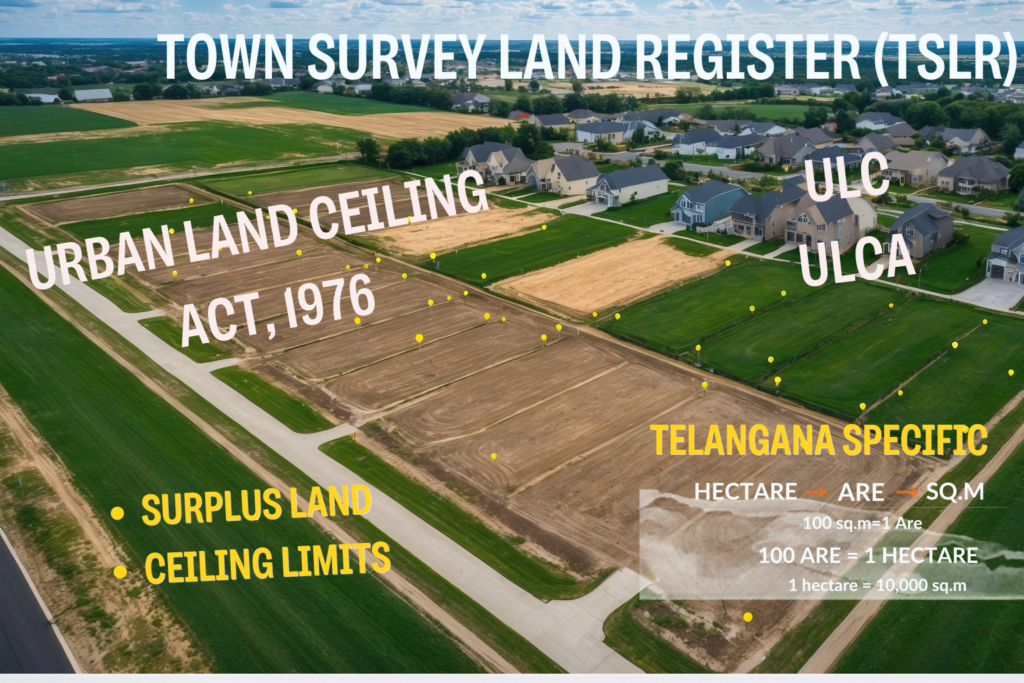 Understanding the “Are” unit: One ‘Are’ = 100 square meters
The “Are” is the crucial middle ground of the metric system used in TSLR land records. To understand the ‘are’ metric unit, we need to know that by definition:
-
- 1 Are = 100 square meters.
-
- 100 Ares is equal to 1 Hectare in area
That means 100 ares is equal to 10,000 square meters, which is also the area of a hectare in square meters.
TSLR records in Hectares, Ares, and Square meters – an ‘Are’ is not an ‘Acre’
The TSLR records the urban lands in Hyderabad and surrounding areas in a hierarchical, survey-style breakdown. The TSLR entry records the overall land area by using three metric units, namely Hectares, Ares, and Square meters.
Yes, it is ‘Ares’, not ‘acres’. The ‘acre’ is a unit used in rural lands. While ‘are’ is the unit used in urban lands. They do not represent the same area. One ‘acre’ is 4840 square yards while one ‘are’ is 100 square metres.
For instance, an example entry made in a TSLR record measures a land parcel as 0 Hectare – 12 Ares – 35 Sq. m. To convert this to square meters, multiply 12 by 100 and add the remaining 35, to calculate the total area to 1235 square meters.
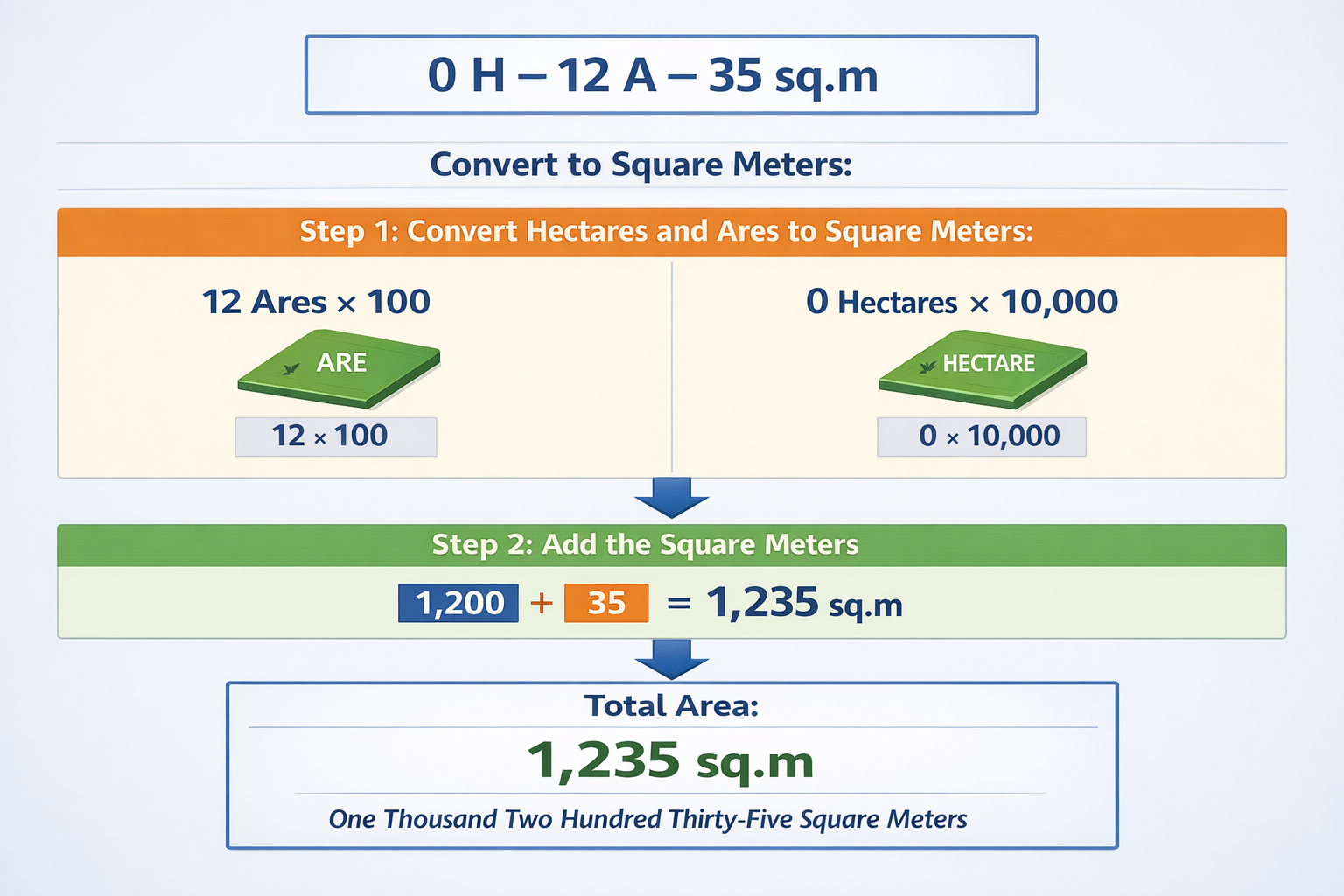
Let us take another example for a land parcel as 1 Hectare, 65 Ares, and 2 sq.m. To convert this to square meters – multiply 1 by 10,000, then multiply 65 by 100 (for Ares to square meters), and then add 2 to the sum of the previous two multiplications to calculate the total area to 16,502 square meters.
Taking a third example, 0 Hectare, 40 Ares, and 8 sq.m – after proper multiplication and calculation, this land parcel will be 4,008 sq.m.
ULCA vs TSLR differences in performing land measurements
The nationwide ULCA defined limits in square metres. However, the TSLR considers the ‘are’ unit as a vital intermediate measuring unit. So, if someone is going through records made in Telangana, they need to perform a detailed calculation involving several steps to deduce the total area in square meters.
Errors in calculation – due to ignorance of one ‘Are’ = 100 Sq.m.
ULCA defined limits in square metres. However, the Telangana TSLR system is recorded in Hectares-Ares-Sqmts with 1 hectare=10000 sq mts and 1 are=100sqmts. There is a need to convert the TSLR measurements into sq. mts. However, there is significant confusion for those unaccustomed to the TSLR format as Hectares-Ares-Sq.mts. which is different from agricultural Acre-gunta format. During this calculations, because of lack of knowledge of the Hectares-Ares-Sqmts format and especially that 1 are=100 sq mts many mistakes/misunderstandings are commonly seen.
The vast majority of revenue officials have good experience in rural areas where the Acre+gunta system is used and don’t have command with the TSLR recording system of Hyderabad. Their knowledge many times is not perfect and many mistakes creep up in the files and correspondence.
As discussed due to various reasons discussed above, both officials and citizens unfamiliar with the “Are” unit might misinterpret a measurement like 0 Hectare 40 Ares and 8 sq.m. Because an “Are” represents exactly 100 square meters, 40 Ares is 4,000 sq.m. When added to the 8 sq. m. remainder, the true total is 4008 square meters. However, a casual observer might mistakenly read the digits together and believe the area is only 408 square meters.
Awareness lost – 50-year long time gap in TSLR record creation
Due to the time lag since 1971-72 Urban surveys and TSLR records creation, there is a lack of awareness of the ‘Ares’ unit of measurement. A value of 0 Hectare, 40 Ares, and 8 sq.m. runs a high risk of misinterpretation as 408 sq.m.
As it has been 50 years since 1971-72 Urban surveys and TSLR records creation. The awareness of recording areas in TSLR as three distinct metric units: Hectares, Ares, and Square meters is not widely known. The ability to properly convert this 3 different units to square meters is also not well known.
Many citizens complain that the revenue officials at various levels themselves are ignorant of this measurement unit. Even those who are aware don’t educate other officials or the public about this measurement unit.
When officials wrongly interpret the land measurement to the public who seek their counsel, they create much confusion and cause wrong choices. Imagine a 4,008 sqm temple area interpreted as 408 sqm, it may cause actions to land grab 3,600 sq.mts. of temple land. This ignorance creates a fertile ground for manipulative touts and brokers to enter the field and do mischief.
Education about the ‘Ares’ unit in TSLR – key to preventing fraud in land records
The common public is experiencing much distress due to a lack of understanding and education about the ‘Ares’ unit. This situation is creating a fertile grounds for touts and brokers to encourage manipulating land areas, especially related to Hindu religious properties.
By misinterpreting the correct temple areas to stake holders, it is encouraging actions to reduce the temple areas and land-grabbing vast areas of temple properties due to a wrong understanding of the TSLR measurement of plot size. This is due to a lack of awareness that the ‘Are’ unit is equal to 100 sq.mts.
For all these above reasons, there is a need for taking urgent action on the proper education of revenue employees especially the younger ones to prevent such fraud.
You may also like to read: