
The Indian tradition of rearing silkworms is the most ancient, and that gifts us the richest specimen of fabrics. Indian silks have permeated the culture and economy of the country since time immemorial. Beginning its journey from the royal courts of the country and passing down to village looms with time, traditional silks are the first choice of women of all ages. Mulberry, Tussar, Eri, and Muga are four common varieties of natural silks. They are particularly reared throughout the country.
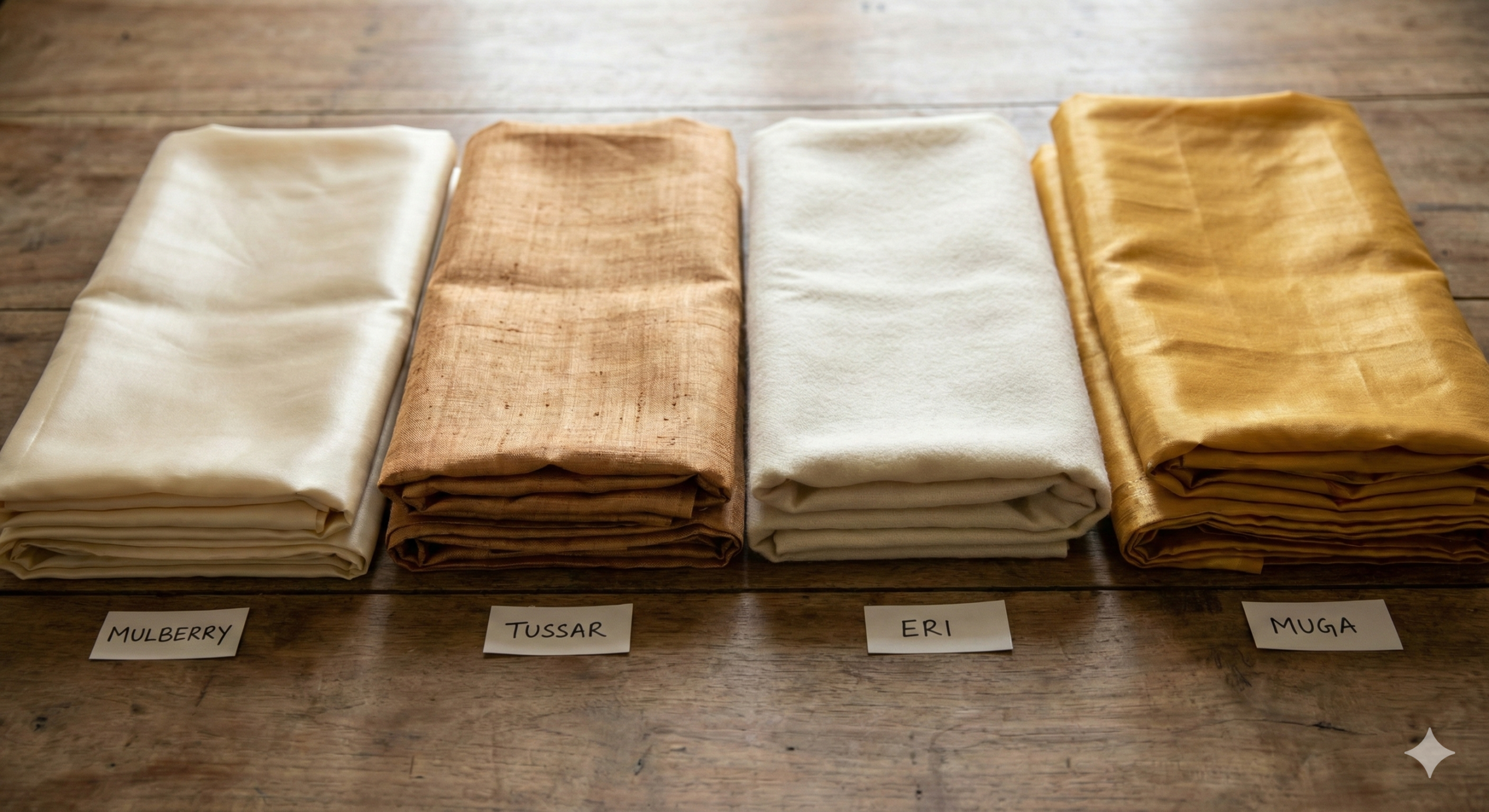
Interestingly, each variety of silk has its own place of origin. They differ in their sheen, texture, and cultural implications. It is the familiarity of their differences that enables buyers, designers, and lovers of textiles to appreciate why every silk is treasured. Moreover, to know how to make the best use of it.
The Mulberry Silk: The traditional Luxury
Mulberry silk has a natural sheen. Its long, straight filament makes it fall well. Its smooth texture has rendered it suitable for high-quality sarees such as Mysore and Kanchipuram varieties. It is compatible with all seasons and is the benchmark of fine silk.
Tussar (Tasar) Silk: The Golden, Natural Material
Tussar silk is produced in different states across India. It is the outcome of a hand-reared silk made from wild silkworms. The characteristic of Tussar is a natural gold or coppery colour which no other silk can imitate. The cloth is a little harsher than mulberry, and extremely light and breathable. Therefore, easy to wear during a hot day. Their power and organic appearance make it popular in tribal and handloom traditions and are often worn as sarees, stoles, jackets, or sets of kurtas, and as ethnic men’s attire.
Eri Silk (Ahimsa or Peace Silk): Conscious and Sustainable
Eri silk, which was created by Samia ricini silkworms, is found in Assam, Meghalaya, and Nagaland. It is called Ahimsa or Peace Silk since the cocoons are harvested after the moth has been hatched, thus the life cycle is complete without murdering the insect. Eri is warm in winter and cool in summer, its breathable fibres make it soft, but matte, and its texture is wool-like.
Eri is strong and wear-resistant, which makes her especially use in shawls, scarves, jackets, and garments promoted as vegan or ethical. The subdued lustre and its strong build are what appeal to conscious buyers.
Muga Silk: The Precious Golden Treasure
In Assam, the most popular Muga is the one that displays a natural golden-yellow hue. Muga is traditionally related to activities of the royal family and ceremonial clothes, traditionally worn as Assamese mekhela chadors and high-end sarees. It is long-lasting and is even shinier after every wash. It is a quality that is highly valued in an heirloom fabric. The fact that it is rare, naturally lustred, and enduring, puts it in a luxury category of its own.
How Indian Silks Differ
Every silk is segregated, according to its texture, lustre, toughness, and seasonal adaptability. Mulberry is shiny, smooth, and medium-weight. It is suitable for every season and formal wear. Tussar is woven with a smooth, golden, shiny texture, robust and suitable in summer. Eri is non-slippery and extremely powerful, ethical, and seasonless. Muga is solid, but light in natural golden colour and has superior quality, and can be draped in tropical weather and with classic luxury wear. Such disparities affect care practices and design.
Conclusion
The four primary types of Indian natural silks produced by Mulberry, Tussar, Eri, and Muga are a source of an astonishing variety of textures, colours, and cultural legends. You want luxury and richness, a touch of the earth, or you want ethical manufacturing, and you want the golden options, with Indian silks that will always be beautiful and impactful.