
Introduction
Both silk and silk-khadi are considered the most luxurious specimens of fabrics. The origin of both fabrics can be traced deep in the Indian textile tradition. Yet, they differ greatly in their origin, production, feel, and meaning. Silk, often referring to smooth and machine-treated mulberry or other sericulture silks (sericulture is the raising of silkworms for silk production), contrasts with silk-khadi, which refers to silk yarns that are handspun and handwoven in the khadi tradition (khadi is a type of handspun and handwoven cloth), or to mixtures with silk woven in the same way as khadi.
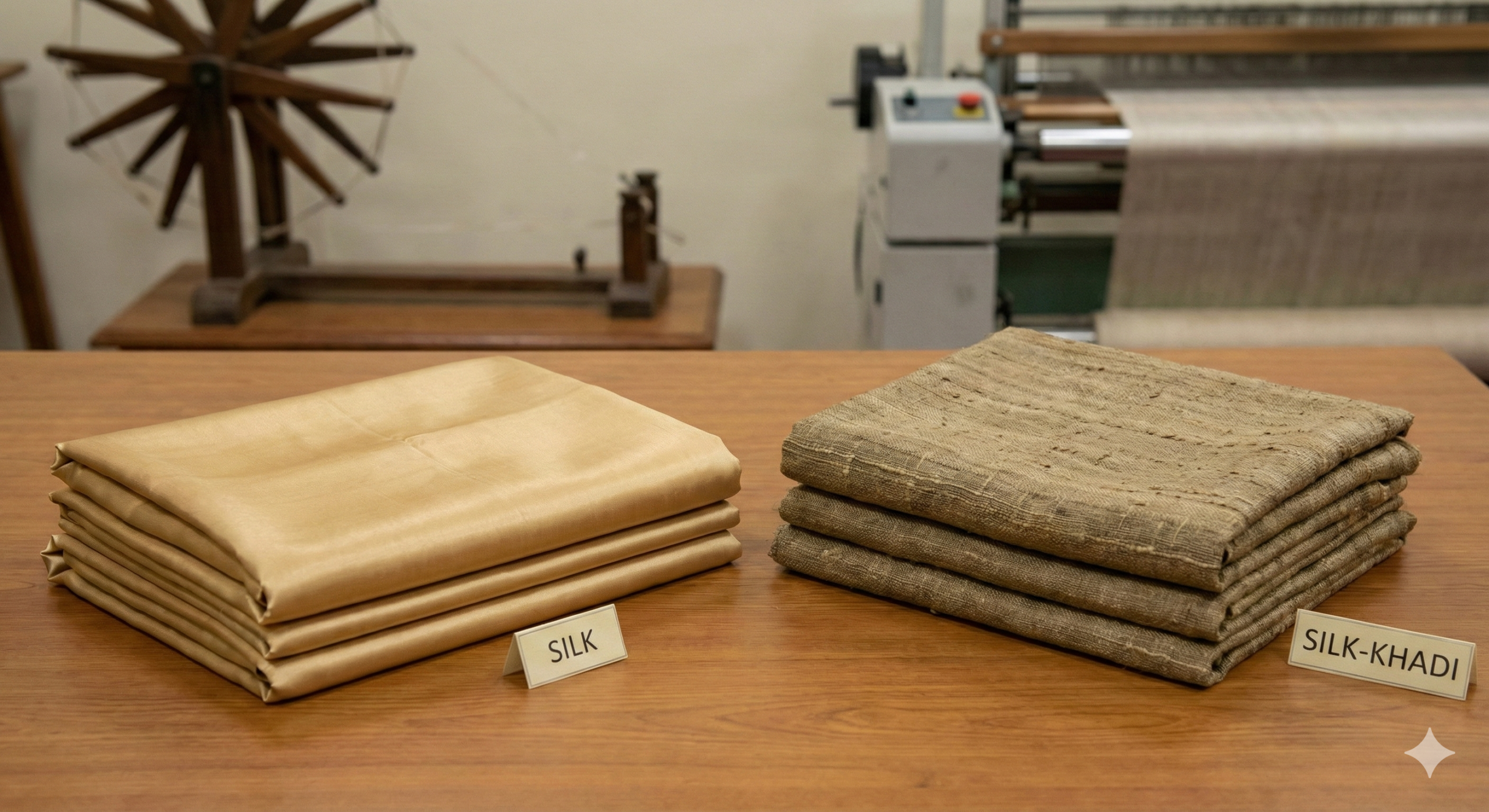
What is silk?
It is described as a by-product of the silkworm, chiefly obtained from the mulberry silkworm. Silk is a natural protein fibre. Traditional silk fabrics are made from powerloom-woven, machine-spun material. The final product brings a classic gleam and smooth hand finish. It is a fine drape and a slightly plainer surface. Silk could be further classified into varieties like mulberry, eri, tussar, and muga. Moreover, each fabric delightfully displays its own discrete texture, colour, and potential.
What is silk-khadi?
Silk-khadi may be handspun and handwoven silk yarns (applying the khadi tradition) or khadi fabrics contain silk as its main constituent (pure silk khadi), or as a blend of silk with other fibres (silk-cotton khadi).
Differences in production and craft
Silk: It is mostly industrialised sericulture, machine reeling, machine spinning, and power loom or mechanised weaving. The product of the process is smooth, consistent yarns and greatly uniform fabrics.
Silk-khadi: It is a process of hand-reeling or hand-spinning silk yarns and handloom weaving. Abnormalities like slubs or minor variations in thickness are not uncommon and are actually praised as an indication of genuineness and humanity.
Touch, look, and adoptability
Silk: Soft, shiny, and fluid drape, it covers the surface and is highly lustrous and has an even reflection. Best when it is desired to look smooth and official.
Silk-khadi: This is usually treated to a matte or faintly muted finish. It has a more feelable surface and is a somewhat firm and stiffer, more organised drape than machine silk. The inconsistencies give it an artisanal nature.
Comfort and breathability
Both are breathable materials and suitable in warm climates, though, due to its spun structure and irregularities in weaves, the handspun khadi may seem airier and more absorbent.
Durability and care
Silk: Mulberry silk is hard but fine, of a good quality. One should treat it with care; it is washed by hand or dry-cleaned using special detergent.
Silk-khadi: It is just as strong, only more forgiving due to the use of thicker handspun yarns. It is sensible to handwash it using a mild soap and dry it tenderly, etc.
Sustainability, cultural value, and ethics
Silk: Traditional methods of silk production are sericulture. It is not essentially cruelty-free. There are also increased water and chemical footprints of industrial silk.
Silk-khadi: Ignores mass production, promotes rural craft and local economies, and can be the one with a smaller carbon footprint. Silk-khadi has a cultural and political meaning in India as an icon of independence and artisanship.
Price and availability
Unadulterated machine silk may be of low cost, up to highly costly, depending on the weave and decoration. Silk-khadi is a hand-made and time-consuming fabric, which usually sells high despite its more rustic appearance.
Styling and occasions
Silk: It all depends on the case of a formal, wedding, or any other occasion that needs a smooth, flowing, silky appearance; then silks are best.
Silk-khadi: Day, Smart-casual, Suits, ethnic minimalism, and suits that need slight smartness with an artisanal background.
Conclusion
Silk and silk-khadi are the same noble fibre. However, they differ dramatically in production, their appearance, and philosophy. Silk comes with a sleek and sensual luxury; silk-khadi comes with a textured, more authentic, moral, and cultural opulence. Select silk to be used as formal lustre and classy drape; select silk-khadi when you need the artisan’s feel, sustainability, and a piece of clothing that glorifies the art of hand and heritage.